Showing posts with label education. Show all posts

Friday, February 7, 2014

Planets, Creation's Afterglow, and Double Stars

Life may have begun nine billion years before Earth was here: if a Harvard astrophysicist is right.
  1. When the Universe was a Habitable Zone
  2. Planets and Double Stars
Science? In a 'religious' blog?? It makes sense.

Both deal with truth, in different ways — Science tells us what things are and how they work. Religion tells us why things are and how we should deal with them. (March 13, 2013)

Life on Earth and, Maybe, Elsewhere

In speculative/science fiction, life on other worlds is limited only by the writer's imagination: and readers' willing suspension of disbelief. Or, for movie producers, talent and budget: not necessarily in that order.

The only place where we know life exists is Earth. Over the last four billion years, critters have flown, crawled, burrowed, and oozed into hot springs, subglacial lakes, and rocks two miles below the surface.

Considering what we're learning about exoplanets, I think it's very likely that we'll find life elsewhere. We've found more than a thousand planets so far, some of which might support life. But right now we don't know if any do.

My opinion puts me in the minority, at least among folks who responded to an informal survey. An article I picked for this week's post asked this question: "Do you believe alien life exists elsewhere in the universe?"

As of Wednesday afternoon (February 6, 2014), 35,393 folks had responded. The results:
  • Yes - We may not have found them yet, but they're out there.
    • 90.19% (31922 votes)
  • No - Aliens are just part of science fiction.
    • 5.06% (1792 votes)
  • I'm not sure
    • 4.74% (1679 votes)
Once in a while I hear someone say that a Catholic shouldn't "believe in" life on other planets. If that means following one of the UFO religions, I agree. Idolatry and my faith don't mix. I'll get back to that. The five percent who claim that "aliens are just part of science fiction" may be reacting to the status of space aliens as celestial saviors in popular culture: or not.

I think assuming that life isn't on other worlds makes as much, or as little, sense as assuming that it does. Whether or not we're alone in the universe is something we'll learn, using science: until we find a better method for studying our world.

My take on space aliens, among other things:

Faith, Reason, and Truth

Seeking truth and seeking God are as compatible as faith and reason.

It's not just my opinion: as a Catholic I must believe that faith is compatible with reason; that God is truth; that truth cannot contradict truth; and that I must seek truth. (Catechism of the Catholic Church, 144.159, 2104)

I must also believe that God created and is sustaining everything. (Catechism, 279, 301)

Because the things of the world and the things of faith both come from the same God, It follows that honest study of this world cannot get in the way of faith. (Catechism, 159)

The notion that science and religion are at war is fairly new.

Nine millennia back, folks in Sumer were recording "some observations of the world with numerical data." (Wikipedia) It wasn't science, quite, but it was systematic study of the world: and ancient Sumerians apparently didn't fear that using their brains angered their gods.

Jumping forward to about 1100, European universities evolved from cathedral and monastic schools that had been around since the Roman Empire broke up. Documents from the ancient world, India, and the Middle East arrived at about the same time.

Albertus Magnus, Machiavelli, and All That

Folks like Roger Bacon, Albertus Magnus, and Duns Scotus weren't scientists in the contemporary sense: but they saw no conflict between worshiping God and studying God's creation. Other Catholics may have felt that ignorance is next to Godliness, but the Church wasn't worried about folks "thinking too much." Not in general, and that's another topic.

Since I'm Catholic, I recognize Albertus Magnus as a patron saint of scientists. During his life, some folks thought he was a wizard and magician: which I think shows that human nature hasn't changed much.

About five centuries ago, quite a few priests and bishops were abusing their authority and getting excessively creative with Church teachings. The situation wasn't as bad, I think, as what we faced from about 1000 to 1200: but instead of folks like Francis of Assisi, this time we got folks like Huldrych Zwingli, John Calvin, and Henry VIII.

While northern princes were encouraging home-grown outfits like the Church of England and Church of Sweden, Protestant leaders were deciding what people in their territories should believe.

What might charitably be called diffidence toward science that threatens their "Biblical" preferences has been with us ever since.

I don't think it helped that some outstanding scientists of the day, like Galileo Galilei and Copernicus were Catholic, and that Europe's first exclusively scientific academy was founded in Rome.

Starting around 1600, the idea that reason and individualism was more important than tradition got started in Europe. There's nothing wrong with reason, and human beings are individuals. The trouble, as I see it, was that reason got elevated to divine status.

Politics was, arguably, involved. Blaming problems on the Catholic Church probably suited national leaders in Europe just fine. A Catholic code of ethics can be troublesome to leaders in their Machiavellian moments.

Being reasonable is a good idea. Honoring and revering reason as if it's a god? That's a very bad idea. Acting as if anything or anyone other that God is divine is idolatry, and strictly against the rules. (Catechism, 2097, 2112-2114)

The Anthropic Principle: Stating the Obvious

If the universe couldn't support conscious life, nobody could observe the universe. The name of this rather obvious conclusion is the anthropic principle.

It's a bit like saying "I see the bird, therefore I exist." Or "I think, therefore I am."

Descartes pointed out that being reasonably certain of one's own existence is important from a philosopher's point of view. I'm inclined to agree that self-awareness is important.

However, although it's important to me, certainty that I exist almost certainly isn't the most important aspect of reality: and that's yet another topic.

One of the scientists whose work I picked for this week's post mentioned the anthropic principle. It's a newish phrase, first used in 1973, although the idea goes back to 1904.

More about life, the universe, and the anthropic principle:
"Anthropic principle"
Wikipedia

"In astrophysics and cosmology, the anthropic principle (from Greek anthropos, meaning 'human') is the philosophical consideration that observations of the physical Universe must be compatible with the conscious life that observes it. Some proponents of the anthropic principle reason that it explains why the Universe has the age and the fundamental physical constants necessary to accommodate conscious life. As a result, they believe it is unremarkable that the universe's fundamental constants happen to fall within the narrow range thought to be compatible with life...."
I'm on about the same page as folks who think "it is unremarkable that the universe's fundamental constants happen to fall within the narrow range thought to be compatible with life."

Someone's probably tried using the anthropic principle to prove that God exists: or doesn't. That makes about as much sense to me as saying "two and two equals four, therefore God exists:" or doesn't exist, for that matter. (January 5, 2014)

God and the Universe, Faith and Science

I am certain that God exists, created everything, and is constantly sustaining this creation. (Genesis 1:1; Catechism of the Catholic Church, 1, 279, 301)

I also recognize that the universe isn't static. It is changing. Since I know about secondary causes, knowing that change happens doesn't interfere with my faith. (Catechism, 302-308)

When I think about my own existence, what we are learning about this vast creation, and the beauty that surrounds us, I see very strong indications of God's existence. These aren't "proofs" in the scientific sense, though. (Catechism, 31-35)

As I've said before, faith does not depend on science, but faith and science can work together.
"...'Consequently, methodical research in all branches of knowledge, provided it is carried out in a truly scientific manner and does not override moral laws, can never conflict with the faith, because the things of the world and the things of faith derive from the same God. The humble and persevering investigator of the secrets of nature is being led, as it were, by the hand of God in spite of himself, for it is God, the conserver of all things, who made them what they are.' "
(Catechism, 159)
Some folks look at the universe and decide that God doesn't exist. Some even imply that because the universe is vast and ancient, God cannot exist. I don't see it that way but I also think that God is eternal and infinite: with all that goes along with those adjectives.

1. When the Universe was a Habitable Zone


(From Erik A. Petigura, via Space.com, used w/o permission.)
"An artist's representation of the 'habitable zone,' the range of orbits around a star where liquid water may exist on the surface of a planet. A new study unveiled Nov. 4, 2013 suggests one in five sunlike stars seen by NASA's Kepler spacecraft has potentially habitable Earth-size planets."
"Did Alien Life Evolve Just After the Big Bang?"
Katia Moskvitch, Space.com (January 31, 2014)

"Earthlings may be extreme latecomers to a universe full of life, with alien microbes possibly teeming on exoplanets beginning just 15 million years after the Big Bang, new research suggests.

"Traditionally, astrobiologists keen on solving the mystery of the origin of life in the universe look for planets in habitable zones around stars. Also known as Goldilocks zones, these regions are considered to be just the right distance away from stars for liquid water, a pre-requisite for life as we know it, to exist.

"But even exoplanets that orbit far beyond the habitable zone may have been able to support life in the distant past, warmed by the relic radiation left over from the Big Bang that created the universe 13.8 billion years ago, says Harvard astrophysicist Abraham Loeb...."
I'm an American, with my culture's somewhat frantic view of time. For me, one year can be a very long time: for everyday matters, at least.

15,000,000 years is a very long time: when compared to the span of recorded history. Looking at it another way, it's very roughly 1/1000th the age of the universe.

We've learned that the universe is about 13,790,000,000 years old. It's been expanding and cooling ever since. Loeb says it was around room temperature 13,775,000,000 years back.

The Solar system didn't start forming until roughly 4,600,000,000 years ago: 9,175,000,000 years after Loeb's room-temperature universe. Unless current models are wildly wrong, Earth has been around about 4,540,000,000 years.

Life of our sort needs liquid water and, probably, a planet made of something other than hydrogen and helium to hold the water. Those elements weren't formed until after the universe was at a comfortable temperature: probably.

By the way, I think referring to "relic radiation from the Big Bang" as creation's afterglow, as I did in this post's title, is an attractive metaphor. It's also a bit parochial, since the Big Bang theory applies to the space time continuum I live in: and that's yet again another topic. (May 30, 2013)

Heavy Elements, Liquid Water, and Lots of "Ifs"
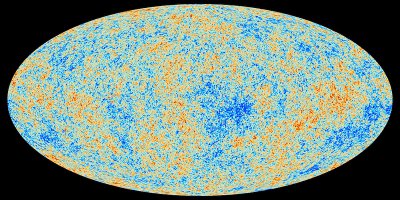

(From ESA and the Planck Collaboration, via Space.com, used w/o permission.)
"A 2013 map of the background radiation left over from the Big Bang, taken by the ESA's Planck spacecraft, captured the oldest light in the universe. This information helps astronomers determine the age of the universe."
"...According to the standard cosmological model, the very first stars started to form out of hydrogen and helium tens of millions of years after the Big Bang. No heavy elements, which are necessary for planet formation, were around yet.

"But Loeb says that rare 'islands' packed with denser matter may have existed in the early universe, and massive, short-lived stars could have formed in them earlier than expected. Explosions of these stars could have seeded the cosmos with heavy elements, and the very first rocky planets would have been born.

"These first planets would have been bathed in the warm CMB radiation, and thus, Loeb argues, it would have been possible for them to have liquid water on their surface for several million years...."
(Katia Moskvitch, Space.com)
Loeb says we can test his theory by looking for planets circling stars with a very low percentage of heavy elements. If we find dense planets around those stars, they'd be similar to his early planets.

If Loeb is right about those rare islands of fast-track element synthesis, and if planets formed from the heavier elements, and if those planets had the right mix of elements: that's a lot of "ifs."

But it's barely possible that life could have started on a planet circling very far from its star: or drifting between stars. There was a brief time when, as far as temperature was concerned, the entire universe was a "Goldilocks zone."

That's an exciting possibility.

"A" Equals "A:" True, but So What?

"...Anthropic reasoning suggests that there might be different values for this parameter in different regions of the multiverse — but our universe has been set up with just the right cosmological constant to allow our existence and to enable us to observe the cosmos around us.

"He [Loeb] says that life could have emerged in the early universe even if the cosmological constant was a million times bigger than observed, adding that 'the anthropic argument has a problem in explaining the observed value of the cosmological constant.'..."
(Katia Moskvitch, Space.com)
My son-in-law and daughter, knowing my interests, gave me "The Book of Useless Information" for Christmas. I keep it near my desk, and occasionally dive in, resurfacing with gems like "the infinity character on the keyboard is called a lemniscate" and "the name for fungal remains found in coal is sclerotinite."

Playing with trivia is fun, as demonstrated by sales of Trivial Pursuit. Interest in comparatively unimportant facets of reality is not new. Thomas Aquinas, in Summa Theologica, asked "can several angels be in the same place?" I'd be astonished if scholars in 1270 were, on the whole, any sillier than today's lot, and I'm getting a little off-topic.

I think there's no harm in discussing whether the existence of a universe which sustains the life of observers is explained by the existence of observers. Provided that the discussion doesn't get in the way of more important matters: like cleaning the coffee maker.

I also think that philosophical insights from physicists may be regarded as seriously as the opinion of film celebrities on international diplomacy.

Their insights and opinions are, I'm sure, important to those individuals: but I am not at all convinced that competence in one field implies competence in another.

2. Planets and Double Stars


(From NASA / G. Bacon, STScI; via Sci-News.com; used w/o permission.)
"This artist's impression shows an extrasolar gas giant orbiting a binary star system."
"Kepler-34b Helps Explain How Circumbinary Exoplanets Form"
Sci-News.com (January 31, 2014)

"Researchers reporting in the Astrophysical Journal Letters have found that the majority of circumbinary planets – planets that orbit two stars – were actually formed much further away from their binary stars and then migrated to their current locations.

"There are few environments more extreme than a binary star system in which planet formation can occur.

"Powerful gravitational perturbations from the two stars on the rocky building blocks of planets lead to destructive collisions that grind down the material...."
Models of planetary development which predicted that binary stars in a close orbit wouldn't have planets were fine: until we started finding planets in orbit around close binaries, like the Kepler-47 system. Those planets weren't a complete surprise, since scientists had already realized that the early Solar system was much livelier than they'd first thought.

Even so, the more we learn about this universe, the more we find that we have to learn. I like living in a world where we're not likely to run out of surprises.
"I have no doubt that in reality the future will be vastly more surprising than anything I can imagine. Now my own suspicion is that the Universe is not only queerer than we suppose, but queerer than we can suppose."
(J. B. S. Haldane, via Wikiquote)
Related posts:

Sunday, July 1, 2012

Reach Youth Ministry: Looks Like a Good Idea

Kristiana Lahr is a college student with roots here in Sauk Centre, Minnesota. She's also Catholic, and involved in something called Reach Youth Ministry:
I found out about her connection with Reach Youth Ministries this morning, when she spoke to the parish after Mass. The outfit's been around since the late '70s, helping folks who are around college age get reacquainted with their Catholic faith: or learn it.

It sounds like a good idea. This sort of activity also takes money, which is where Kristiana Lahr's talk came in. She's raising money for Reach Youth Ministry: and asking for our prayers.

That's where this post comes in. I think Reach Youth Ministry is a good idea, so I'm passing along her request: prayer; and, if possible, financial support.

Reach Youth Ministry website has a Donate page, which is useful if you've got a PayPal account. You may have to be patient, though: their website was a trifle sluggish when I checked this afternoon. My guess is that lots of folks were doing the same thing: seeing what reachym.org looked like.

Related posts:

Sunday, June 17, 2012

Home Schooling, Responsibility, and Me

My wife and I gave our kids a choice when they finished sixth grade. They could stay in the government school system, or be home schooled. Each of them chose home schooling.

The youngest is starting a computer repair business, and will graduate in three years. One is a cartoonist, with a 'day job' to pay the bills; another graduated from college and is running a candle manufacturing company with her husband; and one is a writer.

My wife teaches for other home schooling families in our part of central Minnesota. Some of them want the subject knowledge that she and our third-oldest daughter offer, some need help keeping up with 'schooling' while running a family business.

What each home schooling family I know has in common is that we care about what our kids learn: academically and otherwise.

'Religious or Moral Instruction'

My wife and I home school our kids partly because we're concerned about their "religious or moral instruction." Considering what's shown up in the national news, I'd better explain what "religious or moral instruction" really means. (March 6, 2010)

First, what "religious or moral instruction" doesn't mean. I do not live in fear that my kids will start believing that Earth isn't flat, or learn that the universe is more than 6,000 years old.

As I've said before, "I believe that God created - and is creating - everything. (Catechism of the Catholic Church, 279, 301, 302-305)

"That's not necessarily the same as believing that God the Almighty looks like Charleton Heston's Moses." (January 18, 2012)

Children, Education, and "Primordial Responsibilities"

I'm a practicing Catholic, and a father, so I'm responsible for teaching my children:
"The conjugal community is established upon the consent of the spouses. Marriage and the family are ordered to the good of the spouses and to the procreation and education of children. The love of the spouses and the begetting of children create among members of the same family personal relationships and primordial responsibilities." (Catechism of the Catholic Church, 2201)

"The Christian family is the first place of education in prayer. Based on the sacrament of marriage, the family is the 'domestic church' where God's children learn to pray 'as the Church' and to persevere in prayer. For young children in particular, daily family prayer is the first witness of the Church's living memory as awakened patiently by the Holy Spirit."
(Catechism, 2685)
Granted, not everybody sees education and prayer the way I do:
The Catholic Church doesn't say that my wife and I have to home school our kids. This paragraph, part of a discussion of participation in social life (Catechism, 1897-1917), seems to say that community schools are an option:
"Second, the common good requires the social well-being and development of the group itself. Development is the epitome of all social duties. Certainly, it is the proper function of authority to arbitrate, in the name of the common good, between various particular interests; but it should make accessible to each what is needed to lead a truly human life: food, clothing, health, work, education and culture, suitable information, the right to establish a family, and so on.28"
(Catechism, 1908)
Unhappily, government schools in today's America aren't always particularly good places for kids to hang out. Maybe home schooling won't work for everybody: but I think it's practical for most folks: and better in the long run for most parents and children.

Home Schooling Works

I put this Q & A list together last month. It's based on questions I've been asked, and assumptions I've noticed:
  • Does a home schooling family have to
    • Build a classroom?
      • No
    • Run the student(s) between rooms at 50-minute intervals?
      • No
  • Home schooling is only for
    • Geniuses
      • No
    • People who hate science
      • No
    (May 30, 2012)
Someone with an overabundance of energy and wealth could build an entire school building, complete with gymnasium and a garage for school buses; and replicate every detail of what should happen in government schools. Nobody I know does that, and I don't see why anyone would.

What's needed to home school is, first of all, at least one child between the ages of about six and 18. Having access to a room with adequate light and ventilation, and at least one table and chair, is nice: but education could be conducted in nearly any reasonably comfortable environment.

The point I'm trying to make is that home schooling isn't all that difficult. And the odds are really good that wherever you are, someone nearby is home schooling their kids now: and can either lend a hand, or tell you where to find help.

Here's what got me started:

Home Schooling: Making a Difference

"African-Americans increasingly turn to home-schooling"
Garrett Tenney, FoxNews.com (June 16, 2012)

"It's the end of another school year, and for a growing number of African-American kids, it will be their last outside the home.

"Nationwide, more and more families are choosing to home school their children each year, and the fastest growing segment of the home school movement is African-Americans, experts say. Some 220,000 black children are home-schooled, according to one estimate. 'Each one of them has excelled so much, and I can see it,' Kisha Hayes, of Baton Rouge, La., says of her three children, whom she began home-schooling five years ago. 'I can see the difference in their learning.'..."
The article gets back to the Hayes family, and so will I.

Home Schooling: It's Growing

Let's look at some numbers, from the FoxNews.com article and elsewhere.

United States:
  • Percent of school-age population home schooled
    • 1.7% (1999)
    • 2.9% (2007)
  • Total U.S. population: 313,847,465
    (July 2011 estimate) (United States, "CIA World Factbook" (last updated June 8, 2012))
  • U.S. population, black: 40,329,400 (approx, from U.S. population and percentage data)
    • Black home schooled students: 220,000
      (The National Home Education Research Institute, via FoxNews.com)
Assuming that black Americans/African Americans have about the same age distribution as everyone else: 12.85% of 63,066,000, or 8,103,981, black/African-American children are between the ages of 5 and 19. If that number's reasonably accurate, then the 220,000 home schooled black/African-American students are roughly 2.7% of the total. That's just short of the national average for 2007.

What impressed me wasn't the numbers of families who decided to keep paying government schools, through taxes, and home school their kids. It was how fast that number was growing.

The number of home schooled kids nearly doubled in eight years, from 1999 to 2007.

(If you're interested, The 2012 Statistical Abstract (www.census.gov/compendia/statab/cats/population.html) has a pretty good selection of statistical data. I archived a copy of the table I used, Table 7. Resident Population by Sex and Age, in .pdf format, from www.census.gov/compendia/statab/2012/tables/12s0007.xls (June 16, 2012).)

Threatening the Status Quo

No wonder folks who like the status quo are having fits about 'those people' who home school their kids.

I almost sympathize with government school administrators. Their budgets depend on how many warm bodies they have in the building. When the body count drops, so does their funding.

Protecting My Kids

Very few students are actually killed each year in America's government schools, but there's more to growing up than just being alive when we turn 18. I want my kids to be responsible adults. So do other parents.
"Alkinee Jackson, also of Baton Rouge, began home-schooling her five children after she and her husband saw the attitude and behavior of their oldest son, Alante, worsen. He was only in second grade.

" 'If we allowed him to continue to be there and be influenced, by the time he reached high school he'd already be gone; and we know where he'd end up,' Jackson said...."
(Garrett Tenney, FoxNews.com) [emphasis mine]
'What could possibly go wrong' in a government school? Here's one view:
"...George Noblit, an education sociologist at the University of North Carolina at Chapel Hill, said African-American parents increasingly turn to home-schooling to protect their children from drugs and bullying, as well as to ensure the kids get more individualized instruction.

" 'For African Americans, the current state of education is actually not one that is conducive to kids learning,' Noblit told FoxNews.com. 'More and more kids end up not being served well. African Americans are positively saying, "It's time to find a better educational situation." '...
(Garrett Tenney, FoxNews.com)
It's nice to see someone at a university acknowledge that all is not well in America's education establishment. With due respect to G. Noblit, thought: it's not just African Americans who want to keep their kids away from illicit drugs and bullies.

Knowing Who We Are

There's more to home schooling than keeping kids from getting stoned or beaten. When parents get involved, children get opportunities that don't exist in a classroom.
"...Hayes, who calls her classroom the 'Hayes Homeschool Academy,' said she and her husband are able to spend the kind of one-on-one time with their kids that school teachers couldn't. They can also emphasize subjects they believe public schools don't, including religion and African-American history.

" 'We're able to focus on black history a little bit more than I think public schools would give it,' said Hayes, who moved from San Bernadino, Calif., five years ago. 'We're actually able to learn the things we want to learn, whatever that might be, and I think that would go with any nationality.'..."
(Garrett Tenney, FoxNews.com)
I agree with Hayes, although my family doesn't include 'Norwegian-German-Dutch-Irish-Scots history' in our curriculum. Some of that gets covered in European and world history, of course.

Now that I think of it: shouldn't world history include what's been happening in the Americas, Africa, and eastern Asia? That's another topic.

How we connect with vikings, Lindisfarne, Stonehenge, der Schwarzwald, Nederland, and the rest of the world, comes up now and then while my wife talk about something else. Then there's the explanation for a vulture and a cobra being part of Egyptian royal headgear several millennia back: and that's yet another topic. Topics.

Regulations and All That

Garrett Tenney's article gives a quick overview of State regulation of home schooling parents. New York has the tightest grip: while Texas bureaucrats seem to assume that Texans have common sense, and "only requires instruction on good citizenship, math, reading, spelling, and grammar." (Garrett Tenney, FoxNews.com)

Maybe New Yorkers need more oversight. Or something.

Home Schooled: Decisions and an Opinion

"...Now 15, Alante [Jackson] is preparing to graduate high school a year early. He's taking a Chinese language course online, and deciding whether to major in engineering or medicine in college.

"Kamal Hayes, who at age 16 is a five-year veteran of his mom's 'academy,' said home-schooling has worked out well for him, too.

" 'Nothing against public school,' he said, 'but you're not really missing out on anything.' "
(Garrett Tenney, FoxNews.com)
I couldn't have put it better, myself.

Related posts:

Sunday, June 10, 2012

Coney Island School, 'Offensive' Song, and 'Foreigners'

I understand how deeply offensive "God Bless the USA" can be. I've lived in this country all my life - and grew up two blocks from a college campus. "Understanding" isn't "agreeing," though, and I think this principal made a mistake:
"School pulls patriotic song at graduation, but Justin Bieber's 'Baby' is OK"
Susan Edelman, New York Post (June 9, 2012, Updated June 10, 2012)

"A controversial Coney Island principal has pulled the plug on patriotism.

"Her refusal to let students sing 'God Bless the USA' at their graduation has sparked fireworks at a school filled with proud immigrants.

"Greta Hawkins, principal of PS 90, the Edna Cohen School, won't allow kindergartners to belt out the beloved Lee Greenwood ballad, also known as 'Proud to be an American,' at their moving-up ceremony....
I've gotten the impression that what upsets some Americans most about foreigners is that the foreigners - well, they're just not "American." They haven't learned the conventional establishment attitude yet. I'll get back to that.

"We Don't Want to Offend - - -"

"...It was to be the rousing finale of their musical show at the June 20 commencement. The kids, dressed up for their big day, would wave tiny American flags - which, as the lyrics proclaim, 'still stand for freedom.'

"But Hawkins marched in on a recent rehearsal and ordered a CD playing the anthem to be shut off, staffers said.

"She told the teachers to drop the song from the program.

" 'We don't want to offend other cultures,' they quoted her as explaining...."
(New York Post)
Not wanting to "offed other cultures" is, in my experience, a fairly common reason cited by the establishment. It's almost as popular a reason for suppressing unwanted behavior as "un-American" was in my teens.

The Establishment: New Faces; Same Old Attitude

'The establishment' has changed in some ways. In my 'good old days' Americans who held positions of authority and influence were almost exclusively white men. That's a photo of Principal Greta Hawkins, from the New York Post article. Obviously, it's not 1965 any more.

Today's establishment doesn't look like it did a half-century ago, and has a new set of hang-ups. But the old notion that "freedom" means "doing things my way" is still there.

Let's see how the foreigners feel about being, ah, protected by the principal:

"Move to America to Live Freely"

"...'A lot of people fought to move to America to live freely, so that song should be sung with a whole lot of pride,' said mom Luz Lozada, whose son, Daniel, is in kindergarten.

"The song has been sung at previous school events. Last year's fifth-graders, including another Lozada child, performed it at graduation.

" 'Everybody applauded and whistled,' the mom said. 'They gave it a standing ovation.'

"Parents - many immigrants from Pakistan, Mexico and Ecuador - 'love it,' Lozada said.

"A teacher agreed: 'It makes them a little goosebumpy and teary-eyed. I've never come across anyone who felt it insulted their culture.'..."
(New York Post)
When I was an 'English as a second language' tutor, I got to know a few folks who had recently moved to America. One of them was rather emphatic about preferring America to the country he'd escaped from.

Folks who grow up here don't, I think, always have opportunities to learn why, for almost 236 years, people have been moving to America. On the whole, I like being a country that folks try to break into, and that's another topic.

"Too Grown Up"

The local Department of Education backs up Principal Hawkins. In a way, it's nice to see higher levels of management back up staff decisions.

On the other hand, I'm not sure that the government school bosses are on quite the same page as parents, when it comes to what's "too grown up" for the kids:
"...Department of Education spokeswoman Jessica Scaperotti gave The Post an explanation staffers said they never heard - that Hawkins found the lyrics 'too grown up' for 5-year-olds.

"The song starts: 'If tomorrow all the things were gone, I'd worked for all my life. And I had to start again, with just my children and my wife, I'd thank my lucky stars, to be livin' here today.'

"Scaperotti said the department supports the principal's decision. 'The lyrics are not age-appropriate,' she said....
(New York Post)
"...But Justin Bieber's flirty song about teen romance, 'Baby,' was deemed a fine selection for the show. Hawkins had no problem with 5-year-olds singing lines such as, 'Are we an item? Girl, quit playing.'..."
(New York Post)
I'm familiar with the idea that a song is "too grown up" for five year olds if it expresses love of country, contains the word "God." That sort of belief has, in my experience, often been associated with the belief that kindergartners should start thinking about teenage romance. 'It's never too early to start,' and all that.

I don't agree that it's 'cute' to think of little girls as prepubescent sexpots: but I'm familiar with the idea.

Heavy-Handed Suppression, and Remembering the '60s

What's at issue here is not, I think, the Justin Bieber song's lyrics. It's the heavy-handed suppression of an 'offensive' song.

I don't see a problem with kids saying 'offensive' things like "I'm proud to be an American, where at least I know I'm free...." (anysonglyrics.com)

I do see a problem with someone in authority marching in and banning what kids and their parents enjoy singing. The establishment did that sort of thing in my youth: and now we've got a new establishment.

Come to think of it, maybe Hawkins's heavy-handed suppression of free speech will help this country in the long run. Particularly if more Americans start thinking about 'not what you can do in this country, but what this country's doing to you.'

Immigrants, 'Foreign' Ideas, and Hope

I hope today's immigrants hold on to their 'foreign' ideas, at least for another generation or so. They have the new ideas, old appreciation of freedom, and enthusiasm it takes to make a new start: and help make America better.

Home Schooling, the Government Schools, and Me

Not all school administrators I've dealt with are like Principal Hawkins. But America's government school have a culture and attitudes that I think are good for the establishment: but not good for kids.

That's a major reason why my wife and I home schooled our kids, starting when they entered seventh grade.

Related posts:

Saturday, June 9, 2012

Catholics, Families, and Hope

'Catholics have big families' is a stereotype - but some of us do have more than the fashionable number of children.

A conventional explanation here in America is that Catholics are too stupid, uneducated, and/or superstitious to make the connection between sex and babies. Or that we're too ignorant to realize that 'proper' persons don't have more than one or two children. At most.

I think there's another explanation: but what would I know? I'm one of 'those Catholics,' and 'everybody knows' what they're like. And that's another topic, almost.

Basically, I think Catholics, some of us, have large families because we like children: and because we don't think it's wrong to have hope. I know: that sounds radical. It gets worse. You'll find a little science and statistics in this post. I ranted about science, faith, and reason yesterday. (June 9, 2012)

By the time I'd gotten today's post organized, I realized that it came in three sections. Four, counting what I posted yesterday.

This post is the second in a series of four:
  1. "The World isn't Flat"
    (June 9, 2012)
  2. "Catholics, Families, and Hope"
    (June 9, 2012)
  3. "Population Explosion, Birth Dearth, and a Changing World"
    (June 9, 2012)
  4. "Taking Life a Thousand Years at a Time"
    (June 10, 2012)

Families: So What?

I've posted about "Family Values: Addams and Otherwise" before. (July 12, 2011) I think families are important: and that "family" is something that's designed into human beings. The 20th century saw some imaginative - and disastrous - attempts to run a society with unusual definitions of "family." My opinion.

Today, even when the mother and father leave, we sometimes see children stepping into the abandoned positions. In one case, a half-grown child was punished for supporting what was left of her family:
Children need families. I think adults do, too.

'The Good Old Days,' Remembered

I emphatically do not want to go back to the 'good old days,' where:
  • Dad
    • Goes to work
    • Ignores the kids
    • Takes his wife for granted
  • Mom
    • Stays home in the suburbs
    • Being 'just a housewife'
    • Watching
      • Soaps
      • Commercials with improbably-cheerful women
        • Doing housework in high heels
    (June 2, 2011)
Back in the '60s and '70s I didn't do drugs, join a commune, or get into most other conventional non-conformist activities. I do, however, have some sympathy for those of my generation who did. I remember the 'good old days.' They weren't.

Respect Goes Both Ways

A family is supposed to be a relationship where
  • Children respect their parents
  • Parents respect their children
    • See to it that children learn about our Lord
    (Catechism of the Catholic Church, 2214, 2222, 2685)
There's more to it than that, of course. (Catechism 2201-2233)

Love: It's a Decision

Love is part of families, too. I think the emotional, affectionate, sort of love is important.

But I also realize that love is an act of the will. (Catechism, 1766)

Hope: It's a Virtue

I've been over this before: it's okay to be happy, and hope is a virtue. (May 5, 2011)
"The desire for God is written in the human heart, because man is created by God and for God; and God never ceases to draw man to himself. Only in God will he find the truth and happiness he never stops searching for:
"The dignity of man rests above all on the fact that he is called to communion with God. This invitation to converse with God is addressed to man as soon as he comes into being. For if man exists, it is because God has created him through love, and through love continues to hold him in existence. He cannot live fully according to truth unless he freely acknowledges that love and entrusts himself to his creator.1"
(Catechism of the Catholic Church, 27)

"Hope is the theological virtue by which we desire the kingdom of heaven and eternal life as our happiness, placing our trust in Christ's promises and relying not on our own strength, but on the help of the grace of the Holy Spirit....

"...The virtue of hope responds to the aspiration to happiness which God has placed in the heart of every man; ... Buoyed up by hope, he is preserved from selfishness and led to the happiness that flows from charity...."

"...In every circumstance, each one of us should hope, with the grace of God, to persevere 'to the end'93 and to obtain the joy of heaven, as God's eternal reward for the good works accomplished with the grace of Christ....
"Hope, O my soul, hope. You know neither the day nor the hour. Watch carefully, for everything passes quickly, even though your impatience makes doubtful what is certain, and turns a very short time into a long one. Dream that the more you struggle, the more you prove the love that you bear your God, and the more you will rejoice one day with your Beloved, in a happiness and rapture that can never end.95 "
(Catechism, 1817-1821)
I think folks can mistake blind optimism for hope: but that doesn't seem to be a major problem in today's America.

If anything, folks today seem to need a reminder that there's more to look forward to than doom, despair, and death. And, of course, nuclear winter; global warming; climate change, the ozone hole; and the extinction of all cute, fuzzy animals. And that's yet another topic.

This post is the second in a series of four:
  1. "The World isn't Flat"
    (June 9, 2012)
  2. "Catholics, Families, and Hope"
    (June 9, 2012)
  3. "Population Explosion, Birth Dearth, and a Changing World"
    (June 9, 2012)
  4. "Taking Life a Thousand Years at a Time"
    (June 10, 2012)
Other related posts:

Wednesday, May 30, 2012

Earn Good Grades, Hold Down Two Jobs, Get Thrown in Jail

America's government schools and courts don't always cooperate to punish good students. In this case, though, I can see why a judge wanted to make an example of this 'criminal.'

Honor Student: A Threat to the System

I suppose Judge Lanny Moriarty is just doing his job, protecting the citizens of Houston, Texas, from an 11th-grade honor student. Her behavior is, arguably, a threat to America's education establishment.

This honor student showed shocking lack of respect for America's government schools. She skipped classes! Deliberately!

Her excuse is that, in addition to earning remarkably good grades - she has two jobs, earning money to support herself and her two brothers.

In a way, I can see Judge Moriarty's point. If he lets one student hold down two jobs to support a family, while still earning the grades it takes to be an honor student: other students in Houston might start viewing academic achievement and economic responsibility as acceptable traits.

If anti-establishment ideas like that spread: there's no telling what might happen.

The Establishment Ain't What it Used to Be

In my youth, 'the establishment' was almost entirely white, male, conservative, and seemingly obsessed by fear of commies and rock music. That was then, this is now, and the establishment has changed. A lot.

There's going to be an 'establishment:' folks with the position and power to decide what sort of rules the rest of us follow, and how those rules are enforced. I don't have a problem with that. What aggravates me is when folks in 'the establishment' seem to have lost touch with what the rest of us think is important. (September 15, 2011, January 26, 2010)

Honor Student Jailed for Supporting Family

Like I said, I can almost see Judge Moriarty's point. This honor student's behavior, if unpunished, might encourage other students to get good grades while holding down jobs.

Left unchecked, that sort of energy, responsibility, and achievement, might undermine dependence on the establishment.

"Group raises more than $70G for Texas honor student jailed for truancy"
Cristina Corbin, FoxNews.com (May 30, 2012)

"A Louisiana group has raised more than $70,000 for a 17-year-old Texas honor student jailed for missing too much school because she worked two jobs to support her siblings.

"Diane Tran, an 11th-grade honor student at Willis High School near Houston, was sent to jail for 24 hours last week by Judge Lanny Moriarty and ordered to pay a $100 fine for excessive truancy.

"...Judge Moriarty told KHOU 11 News that he intended to make an example of Tran by placing her in jail.

" 'If you let one run loose, what are you going to do with the rest of them? Let them go, too?' Moriarty told the station...."
I put a longer excerpt from that article at the end of this post.1

Home Schooling isn't For Everyone

My wife and I have home schooled our kids for seventh through 12th grades. It worked for us, and worked very well.

Not everybody is in our position, though. Diane Tran's parents separated, her mother moved away: and apparently she's the one left with the ability and responsibility of supporting herself and her siblings.

It isn't an ideal situation, but I don't think throwing her in jail will improve Diane Tran's domestic situation.

There's quite a lot going on here: judicial foolishness; family problems; and economic issues. I think those are serious issues.

I'm going to focus on America's government schools, and a sane alternative.

Home Schooling Can Work For Many

My wife and I had to deal with a school administration that, understandably, didn't want us to deprive the system of warm bodies. School funding is based on enrollment, and fewer bodies means that the school administrator gets less money from the state.

My wife and I researched what State of Minnesota regulations actually said, filled out the forms that were needed, ignored the rest, and went ahead with teaching our kids.

The 'teaching' part isn't as hard as it may sound. Maybe this list will answer some questions:
  • Does a home schooling family have to
    • Build a classroom?
      • No
    • Run the student(s) between rooms at 50-minute intervals?
      • No
  • Home schooling is only for
    • Geniuses
      • No
    • People who hate science
      • No
I've posted about home schooling, what it really is, and some of the weird ideas about it, before.

Related posts:
Background (from September 17, 2011):

1 Excerpt from the news:
"Group raises more than $70G for Texas honor student jailed for truancy"
Cristina Corbin, FoxNews.com (May 30, 2012)

"A Louisiana group has raised more than $70,000 for a 17-year-old Texas honor student jailed for missing too much school because she worked two jobs to support her siblings.

"Diane Tran, an 11th-grade honor student at Willis High School near Houston, was sent to jail for 24 hours last week by Judge Lanny Moriarty and ordered to pay a $100 fine for excessive truancy.

"It's unclear how many days Tran missed, but state law reportedly permits only 10 absences in a six-month period.

"Tran, who works full-time at a dry-cleaning business and part-time for a wedding planner, has been supporting her brother and sister since her parents separated and her mother moved away.

"Houston Councilman Al Hoang and others have roundly criticized the judge, saying he should have used some discretion in the honor student's case....

"...Since the girl's story went viral, hundreds of people have rallied to raise money for the teen, including one group, Louisiana Children's Education Alliance, which said Wednesday it had raised more than $70,000 for Tran.

"The group, which created a website called HelpDianeTran.com, has received donations from 47 states and 13 foreign countries for the girl.

" 'I think this story of a student who's obviously working so hard and is being taken advantage of by the system just touches your heart strings and it affects a lot of people, the group's president, Charlie Davis, said Wednesday in an interview with Fox News.

" 'I think Diane unfortunately is at the center of two failed systems in America -- our public education system and our judicial system,' he said. ...

"...Judge Moriarty told KHOU 11 News that he intended to make an example of Tran by placing her in jail.

" 'If you let one run loose, what are you going to do with the rest of them? Let them go, too?' Moriarty told the station...."

Like it? Pin it, Plus it, - - -

Pinterest: My Stuff, and More

Advertisement

Unique, innovative candles


Visit us online:
Spiral Light CandleFind a Retailer
Spiral Light Candle Store

Popular Posts

Label Cloud

1277 abortion ADD ADHD-Inattentive Adoration Chapel Advent Afghanistan Africa America Amoris Laetitia angels animals annulment Annunciation anti-catholicism Antichrist apocalyptic ideas apparitions archaeology architecture Arianism art Asperger syndrome assumptions asteroid astronomy Australia authority balance and moderation baptism being Catholic beliefs bias Bible Bible and Catechism bioethics biology blogs brain Brazil business Canada capital punishment Caritas in Veritate Catechism Catholic Church Catholic counter-culture Catholicism change happens charisms charity Chile China Christianity Christmas citizenship climate change climatology cloning comets common good common sense Communion community compassion confirmation conscience conversion Corpus Christi cosmology creation credibility crime crucifix Crucifixion Cuba culture dance dark night of the soul death depression designer babies despair detachment devotion discipline disease diversity divination Divine Mercy divorce Docetism domestic church dualism duty Easter economics education elections emotions England entertainment environmental issues Epiphany Establishment Clause ethics ethnicity Eucharist eugenics Europe evangelizing evolution exobiology exoplanets exorcism extremophiles faith faith and works family Father's Day Faust Faustus fear of the Lord fiction Final Judgment First Amendment forgiveness Fortnight For Freedom free will freedom fun genetics genocide geoengineering geology getting a grip global Gnosticism God God's will good judgment government gratitude great commission guest post guilt Haiti Halloween happiness hate health Heaven Hell HHS hierarchy history holidays Holy Family Holy See Holy Spirit holy water home schooling hope humility humor hypocrisy idolatry image of God images Immaculate Conception immigrants in the news Incarnation Independence Day India information technology Internet Iraq Ireland Israel Italy Japan Jesus John Paul II joy just war justice Kansas Kenya Knights of Columbus knowledge Korea language Last Judgment last things law learning Lent Lenten Chaplet life issues love magi magic Magisterium Manichaeism marriage martyrs Mary Mass materialism media medicine meditation Memorial Day mercy meteor meteorology Mexico Minnesota miracles Missouri moderation modesty Monophysitism Mother Teresa of Calcutta Mother's Day movies music Muslims myth natural law neighbor Nestorianism New Year's Eve New Zealand news Nietzsche obedience Oceania organization original sin paleontology parish Parousia penance penitence Pentecost Philippines physical disability physics pilgrimage politics Pope Pope in Germany 2011 population growth positive law poverty prayer predestination presumption pride priests prophets prostitution Providence Purgatory purpose quantum entanglement quotes reason redemption reflections relics religion religious freedom repentance Resurrection robots Roman Missal Third Edition rosaries rules sacramentals Sacraments Saints salvation schools science secondary causes SETI sex shrines sin slavery social justice solar planets soul South Sudan space aliens space exploration Spain spirituality stem cell research stereotypes stewardship stories storm Sudan suicide Sunday obligation superstition symbols technology temptation terraforming the establishment the human condition tolerance Tradition traffic Transfiguration Transubstantiation travel Trinity trust truth uncertainty United Kingdom universal destination of goods vacation Vatican Vatican II veneration vengeance Veterans Day videos virtue vlog vocations voting war warp drive theory wealth weather wisdom within reason work worship writing

Marian Apparition: Champion, Wisconsin

Background:Posts in this blog: In the news:

What's That Doing in a Nice Catholic Blog?

From time to time, a service that I use will display links to - odd - services and retailers.

I block a few of the more obvious dubious advertisers.

For example: psychic anything, numerology, mediums, and related practices are on the no-no list for Catholics. It has to do with the Church's stand on divination. I try to block those ads.

Sometime regrettable advertisements get through, anyway.

Bottom line? What that service displays reflects the local culture's norms, - not Catholic teaching.