Showing posts with label Vatican II. Show all posts

Sunday, July 18, 2010

Caritas in Veritate: Time, Change, and the Church

I mentioned, in my last post about Caritas in Veritate, that the encyclical's section 11 is 500 word long. That's a long paragraph.

The two paragraphs I'm reading today are shorter: an average of about 253 word each.

No wonder so many seem to read the 'gospel according to Newsweek,' instead of keeping up on what the Holy See is saying.

That's not a criticism of the Vatican's literary style. I could condense those 500 words of section 11 to "God matters:" but I'd be leaving out a very great deal of important detail.

The point is, I'm jotting down a few points I notice while reading. If you want what Caritas in Veritate says: read it. I'm using the Vatican's English translaiton, online.

'Vatican II Changed Everything?'

One thing about the Catholic Church that I think quite a few folks - Catholic and otherwise - have trouble with is that its teachings never change - and are always changing.

I've used our rules about liturgical dance as an example. It's forbidden. And encouraged. Depends on where you are. That's not being inconsistent. The Catholic Church is literally universal, and dance doesn't mean the same thing in every culture.

Then there was Vatican II. Some folks here in America saw the weird antics committed 'in the spirit of Vatican II,' and got the idea that the Holy See had gone insane. The actual documents of Vatican II, the ones I've read, don't support the Cromwellian tradition-smashing that went on here. But that's another topic.

I discussed some of the Vatican II connection to Caritas in Veritate, when I wrote about my take on sections 10 and 11.

Section 12 gives what I think is a pretty good discussion of how the Catholic Church takes received truth and shines it on the times and places we pass through:
"The link between Populorum Progressio and the Second Vatican Council does not mean that Paul VI's social magisterium marked a break with that of previous Popes, because the Council constitutes a deeper exploration of this magisterium within the continuity of the Church's life[19]. ... Coherence does not mean a closed system: on the contrary, it means dynamic faithfulness to a light received. The Church's social doctrine illuminates with an unchanging light the new problems that are constantly emerging[22]. This safeguards the permanent and historical character of the doctrinal 'patrimony'[23] which, with its specific characteristics, is part and parcel of the Church's ever-living Tradition[24]...."
(Caritas in Veritate, section 12)

Times Change, The Church Doesn't - and it Does

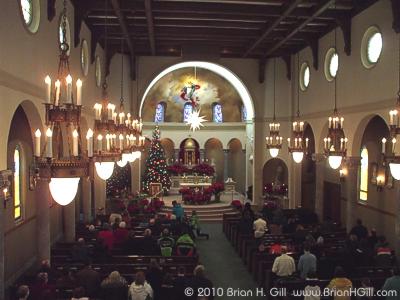
First-century Rome wasn't like Ming Dynasty China,1 or feudal Britain, or 21st-century Minnesota. The Catholic Church has adapted its one unchanging message to many people, in many times: which explains the tree that we drag inside before Christmas each year in my part of the world. (January 10, 2010)

Section 12 wasn't about evergreen trees, of course. The topic at hand was the Church's social magisterium. Picking up where that excerpt left off:
"...Social doctrine is built on the foundation handed on by the Apostles to the Fathers of the Church, and then received and further explored by the great Christian doctors...."
(Caritas in Veritate, section 12)
At this point, Caritas in Veritate is still reflecting on Populorum Progressio, a document that was part of the Church's efforts to implement the Vatican II teachings.

Again, what the Catholic Church was trying to do with Vatican II: not what groovy gurus and magazine subscribers here in America thought was kinda now and kinda wow. My take on Populorum Progressio and Caritas in Veritate is in that other post.

Section 13 continues with Paul VI's handling of Catholic social doctrine in the 20th century. By then, the rest of the world was catching up to the Church, in terms of having globe-spanning social systems. Which was a sort of good news - bad news situation:
"...he grasped the interconnection between the impetus towards the unification of humanity and the Christian ideal of a single family of peoples in solidarity and fraternity. In the notion of development, understood in human and Christian terms, he identified the heart of the Christian social message, and he proposed Christian charity as the principal force at the service of development. Motivated by the wish to make Christ's love fully visible to contemporary men and women, Paul VI addressed important ethical questions robustly, without yielding to the cultural weaknesses of his time."
(Caritas in Veritate, 13)
Today, in at least some American subcultures, we don't have to convince folks that people living in another country are people worthy of respect and to be treated as fellow-creatures: not 'natives.' That's the good news, as I see it. The bad news is that the global culture is no more perfect than the national ones which we're more accustomed to dealing with.

I'm not discouraged, though. The successors of Peter have the same assurance that Jesus gave the fisherman. That's good enough for me. (Catechism of the Catholic Church, 552, Matthew 16:18)


Links to other posts about my study of Caritas in Veritate:
1 Ming Dynasty China? Yep: Catholics were there. Franciscans.

Thursday, July 8, 2010

Caritas in Veritate: Charity, Hungry Nations of the World, and the Catholic Church

It's been several months (January 31, 2010) since I posted about Caritas in Veritate (Charity in Truth). As I wrote then, my opinions and observations are my own. I do my best to make sure that they're in line with Catholic teaching. Still, bear in mind that I speak with the authority of some guy with a blog.

I see that my next bit of Caritas in Veritate to read and study is section 10.

"The hungry nations of the world cry out to the peoples blessed with abundance."

The tenth section of Caritas in Veritate starts with a reference to the four-decade-old (plus a few years) Populorum Progressio, Encyclical of Pope Paul VI on the Development of Peoples (March 26, 1967). A few paragraphs in, that document reads:
"...The hungry nations of the world cry out to the peoples blessed with abundance...."
(Populorum Progressio)
This, from the "conservative" Catholic Church? I've discussed the Church's failure to fit neatly into contemporary political niches before. (November 3, 2008)

Anyway, the section ends with:
"...The correct viewpoint, then, is that of the Tradition of the apostolic faith[13], a patrimony both ancient and new, outside of which Populorum Progressio would be a document without roots — and issues concerning development would be reduced to merely sociological data."
(Caritas in Veritate, section 10)
Terms like "Tradition" have a particular meaning, in the context of Catholic teaching - I've put links to definitions and discussions of our 'odd' words in one of this blog's pages.

That's a Really Long Paragraph

I'd be a little more concerned that the Catholic Church was okay with 'liberation theology,' after reading those passages: if I hadn't done my research earlier. (March 1, 2010)

Section 11 is an example, I think, of why so many people don't read documents produced by the Catholic Church. It's one paragraph: that's just over 500 words long. It's a moderately intimidating acreage of words.

I'd have written "verbiage," but that can mean "overabundance of words." (Princeton's WordNet) I wouldn't say that there are 'too many words.' I've read passages - in and out of academia - where the author apparently tried to simulate erudition with protracted passages of polysyllabic discourse.

I can sling words pretty well, but think a bumper sticker said it best: eschew obfuscation.

Not 'In the Spirit of Vatican II'

Here in America, liturgical weirdness done "in the spirit of Vatican II" encouraged folks who hadn't read the actual documents to think that the Vatican had lost its collective mind. Or turned to heresies.

They were wrong - but there are many American Catholics who seem convinced that the 'real' Catholic Church was 'pre-Vatican II.' I've discussed that 180-proof 'spirit of Vatican II' before. (April 25, 2010, May 7, 2010)

That's important to remember, since Populorum Progressio was written just after Vatican II, and was part of the Church's attempt to put the second Vatican council's ideas into action. The council's ideas. Not what some groovy guru felt the council should have meant.

Here's what Pope Benedict XVI wrote in Caritas in Veritate:
"...I too wish to recall here the importance of the Second Vatican Council for Paul VI's Encyclical and for the whole of the subsequent social Magisterium of the Popes. The Council probed more deeply what had always belonged to the truth of the faith, namely that the Church, being at God's service, is at the service of the world in terms of love and truth. Paul VI set out from this vision in order to convey two important truths. The first is that the whole Church, in all her being and acting - when she proclaims, when she celebrates, when she performs works of charity - is engaged in promoting integral human development...."
(Caritas in Veritate, section 11)
Okay, I think I followed that. The Church, among other things, should do works of charity: and by doing so promote "integral human development."

Let's look at Pope Paul VI's second point, as discussed by Pope Benedict XVI:
"...The second truth is that authentic human development concerns the whole of the person in every single dimension[16]. Without the perspective of eternal life, human progress in this world is denied breathing-space. Enclosed within history, it runs the risk of being reduced to the mere accumulation of wealth; humanity thus loses the courage to be at the service of higher goods, at the service of the great and disinterested initiatives called forth by universal charity...."
(Caritas in Veritate, section 11)
I think the "without the perspective of eternal life" idea is important. Without the 'big picture,' I think that material well-being starts looking like Ecclesiastes 1:2-4 - and what follows in that chapter.

There's a wealth of detail, explaining why this is so, but I think the rest of section 11 might be boiled down to the idea that even well-intentioned efforts to help people will cause trouble, if we leave God out of the equation.

As the section concludes:
"...Only through an encounter with God are we able to see in the other something more than just another creature[17], to recognize the divine image in the other, thus truly coming to discover him or her and to mature in a love that 'becomes concern and care for the other.'[18]"
(Caritas in Veritate, section 11)

Links to other posts about my study of Caritas in Veritate:

Wednesday, June 2, 2010

Roman Missal, Third Edition: I've got Hopes, and Fears

It's out: the new Catholic Missal:
  • "Roman Missal," Third Edition
    From the Committee on Divine Worship (© 2006, 2008)
That link takes you to an introductory page on the United States Conference of Catholic Bishops (USCCB) website - which also lists "Roman Missal | Workshops for Priests | and Diocesan Leaders" this year, from April 15-16 in Cincinnati, Ohio; to November 4-5 in Orlando, Florida.

I see one in Minnesota has already happened (May 24-25).

I've heard and read quite a bit about this: mostly from folks who are looking forward to the new Roman Missal. Quite a few of them expect great things from it.

They may be right.

I haven't done more than read a few of the 'before and after' selections - which look okay to my unschooled eye.

I sincerely hope that implementation of the Roman Missal - Third Edition goes better than the documents of Vatican II. The documents - what I've read of them - are fine. Problems in the AmChurch came, in my view, from wunderkinds who, apparently having gotten their theological training from reading Newsweek, wreaked havoc "in the spirit of Vatican Two." I've wondered if the spirit was around 180 proof. Which I've said before.

Me? I think that the Holy See has realized that they have to exercise quality control with their English translations. The current English translation of the Catechism of the Catholic Church is an example of this awareness at work.

I also hope - sincerely - that Bishops in this country will follow through and see to it that what the Holy See has said to do gets carried out. We don't need another round of (I trust well-intentioned) enthusiastic wannabe theologians deciding that they know what's in documents from the Vatican - without reading them.

Friday, May 7, 2010

Meatless Fridays and All That

'Everybody knows' that Catholics aren't allowed to eat meat on Friday. Or on Fridays during Lent. Or on Ash Wednesday and Good Friday. Or something like that.

For once, 'everybody' is pretty close to being right. Practicing Catholics in America, age 19 to 59, were expected - required - to fast Ash Wednesday and Good Friday in the Lenten season this year. On top of that:
"...Fridays in Lent are obligatory days of complete abstinence (from meat) for all who have completed their 14th year...."
("Let us offer a reminder on the Church's fasting and abstinence teachings:" The Lenten Season, United States Conference of Catholic Bishops)

How Medieval! Don't Those Catholics Know That Some People Shouldn't Fast?!

If those meatless Fridays and, seperately, fasting on two days during Lent seems extreme - even dangerous - don't worry. The Catholic Church has you covered:
"...Fasting-By refraining from eating, we signify our oneness with the Lord, acknowledge our need for conversion, and give witness to our solidarity with those less fortunate. Catholics who are eighteen years and older and in good health are bound until their fifty-ninth birthday by the obligation to fast on Ash Wednesday and Good Friday. Traditionally, the canonical obligation of fasting has been understood in the Church as the taking of only one full meal a day...."
(Forms of Penance, "Let us offer a reminder on the Church's fasting and abstinence teachings:," The Lenten Season, United States Conference of Catholic Bishops )
People who aren't man- or woman- high yet, or have managed to survive almost six decades, aren't expected to fast. Neither are folks who can't, because their bodies won't take the strain.

I'm diabetic, so fasting wouldn't be a particularly good idea. I'm right on the age cutoff, too. My wife is quite a bit younger than I am, but she can't fast for other medical reasons.

How Apostate! We're the Only Real Catholics Left!

Quite a few people feel that the Catholic Church isn't -
  • Really Catholic
  • Christian
  • Holy
  • Whatever
- for a hodgepodge of reasons. Persons with social and intellectual aspirations often decide to say that all religions are anti-social. Except for a few cool Eastern ones, maybe. A few say that all religions are "bad," forgetting that "good" and "bad" are supposed to be cultural conventions. Which is another topic.

Quite a few Catholics around my age remember the "good old days," before Vatican II 'ruined' everything. They generally were born into the Church, and have very nice memories of "pre-Vatican II" practices. And, very often, had unpleasant experiences involving the "in the spirit of Vatican II" weirdness that hit the AmChurch.

Judging from the results, some of that "in the spirit of Vatican II" stuff was about 180 proof. Drunk by a teetotaler.

As an adult convert to Catholicism, I have no fond childhood memories of the Church before Vatican II. I'd heard of Vatican II, of course: but I did what many 'experts' and professional theologians apparently hadn't. I read the documents of Vatican II. Not all of them - but I've studied them as issues come up in my life.

Those "secret" documents that the Catholic Church 'doesn't let anybody read?' Most of them are online. Here's a link to the Vatican II documents:They're available in Byelorussian, Chinese, Czech, English, French, German, Italian, Latin, Portuguese, Spanish, and Swahili. (What! No اردو or தமிழ் அரிச்சுவடி?! I've written about the Vatican's 'vast resources' before. (April 11, 2010))

If your church had the altar rails torn out, the Tabernacle hidden, and go-go girls introduced to Saturday Night Mass: my sympathies. That was groovy theology and disco: not Vatican II. Don't take my word for it: look it up.

Liturgical dance, by the way, is forbidden in Western cultures. Eastern? That's another story. (January 10, 2010)

Meatless Fridays and Fasting Died With Vatican II, Right?

Here's an excerpt from an old Catholic document:
"...Wherefore, we ask, urgently and prayerfully, that we, as people of God, make of the entire Lenten Season a period of special penitential observance. Following the instructions of the Holy See, we declare that the obligation both to fast and to abstain from meat, an obligation observed under a more strict formality by our fathers in the faith, still binds on Ash Wednesday and Good Friday. No Catholic Christian will lightly excuse himself from so hallowed an obligation on the Wednesday which solemnly opens the Lenten season and on that Friday called "Good" because on that day Christ suffered in the flesh and died for our sins...."
(Pastoral Statement on Penance and Abstinence)
That may sound very pre-Vatican II. All that "Wherefore" and "obligation" and stuff like that. That's an excerpt from "A Statement Issued by the National Conference of Catholic Bishops." Dated November 18, 1966.

Vatican II wrapped up November 21, 1965: almost a year before the USCCB issued that statement. And no, that wasn't the AmChurch defying apostate Rome. The American bishops were just doing their job, passing along what Headquarters had to say.

Too bad so many American priests didn't read the memo.

It's true: Vatican II made adjustments in the way the Catholic Church works. But the American weirdness, at least, was the result of 'experts' and 'theologians' in this country getting together and discussing the 'Gospel According to Newsweek,' and what they felt would be real groovy. All done "in the spirit of Vatican II," of course.

I've got a start on a post about Vatican II - but that's yet another topic.

Meatless Fridays and My Wife's Cooking

My household abstains from "meat" (meat from mammals and birds, that is) each Friday, year-round. We've been doing that for a few years now.

No big deal: I figure that if it's a good idea during Lent, it's a good idea for the rest of the year. Not because I want to punish myself and my family: but to give us one more reminder of our Lord.

There's just one problem, sort of. With my wife's cooking: those meatless meals taste 'way too good to be considered abstinence or penance.

Vaguely-related posts, mostly about Friday and the Vatican:More:

Sunday, April 25, 2010

A Young Man With 'Old' Ideas, Vatican II, and the AmChurch

I'll use a comment I left on another blog's post, to introduce a rather remarkable video.

A remark about "the old ways" in that comment needs a little intro, itself. The blogger whose post I commented on was under the impression, I discovered, that the young man was discussing Catholic beliefs which had been done away with by Vatican II.

I can see how someone could get that impression.

Some parishes have been treated to - imaginative - ideas: presented "in the spirit of Vatican II." In America, "in the spirit of Vatican Two" is a phrase that seems to mean something like "I heard about something called Vatican II that changed everything, so I'll say this groovy idea is 'in the spirit of' Vatican II."

That's where we got 'find the Tabernacle' church designs, flower pots being used as chalices, and once - so I've heard - the host sewn into a banner. All very groovy, all done "in the spirit of Vatican II," and all seriously not what the Holy See had in mind for the AmChurch.

If you've heard a priest say that some weird practice was a Vatican II thing: I believe it. We've had quite a bit of trouble with a (mercifully small) number of priests over the last few decades. (April 11, 2010, for starters) And it hasn't all involved trouble with their zippers.

Me? I'm not a professional theologian, so I actually read the Vatican II documents, as issues came up. Which is another topic.

That Video About a Young Man With His Head Screwed on Straight: Didn't Think I'd Get to It, Did You? ;)

Here's that comment:
"As you said, *he gets it!*

"This was a good way to spend 8:16.

"One point, though: I don't know that these are, strictly speaking, 'the old ways.' They're God's ways, as taught by his Church. These ways were introduced to time quite a long while ago, and in that sense they're 'old.'

"On the other hand, the last I heard, God isn't 'in' time the way we are. And I'm not sure that we have a word for the 'direction' God is from 'now.' The closest we seem to come is phrases like, 'Who was, and is, and is to come.'

"Just a thought."
And here's the video:

"Crazy Catholic Guy talking...

GabiAfterHours, YouTube (April 8, 2010)
video, 8:16

"For some reason I look more tired with every video, but I feel the same... Guess its called getting old."

If the video doesn't play back well: Try viewing it on YouTube. I've done a little formatting to make it fit in this blog's format. My code and a few browsers don't play well together, so: like I said, try it on YouTube.

Am I surprised? Not really: I remember being around the age of this young man. Several decades back. I wanted to find a system of belief that made sense, along with quite a few other people.

GabiAfterHours found the right answer a whole lot faster than I did, but maybe he had a better starting point that mine.

Which is okay: It's been an eventful ride. Which is yet another topic.

Not-completely-unrelated posts:
A tip of the hat to AncientSoul and alwayscatholic, on Twitter, for the heads-up on this video.

Wednesday, March 24, 2010

Which Way the Priest Faces

I converted to Catholicism well after the sixties, Vatican II, and the weird "in the spirit of Vatican II" stuff. Quite a lot that went down in American churches that were nominally Catholic wasn't in the Vatican II documents - and wasn't "in the spirit of Vatican II", either. Which is another topic.

One of the things that happened then was that the altar 'got turned around.' Instead of the priest facing the altar with his back to the congregation, he was facing the altar, and the folks in the pews.

Some Catholics at the time who had grown up with the older ways and realized that there was something drastically wrong with some of the new practices, like keeping the consecrated Host in a cloth bag between Masses, figured that the priest facing the congregation was just one more bogus notion.

Interestingly, it wasn't. I know about the pre-Vatican II practices at Mass, and the new ones. I sort of like the older traditions. But that's not the way we do it now, in America.

And, that's okay. The Catholic Church takes local culture into account, and I suspect that's part of what was going on in this case. It looks like the locals here really didn't like having the priest face away from them - and, more to the point, might be getting the wrong idea about what was going on.

It's like the ban on liturgical dance in Catholic churches - in the West. Elsewhere, it's a good idea: and encouraged.

Maybe the Church decided that the locals here in America and other places had to have another one of their cultural foibles accommodated, about where to put the priest.

Related post:More:

Like it? Pin it, Plus it, - - -

Pinterest: My Stuff, and More

Advertisement

Unique, innovative candles


Visit us online:
Spiral Light Candle  • Find a Retailer
• Spiral Light Candle Store

Popular Posts

Label Cloud

1277 abortion ADD ADHD-Inattentive Adoration Chapel Advent Afghanistan Africa America Amoris Laetitia angels animals annulment Annunciation anti-catholicism Antichrist apocalyptic ideas apparitions archaeology architecture Arianism art Asperger syndrome assumptions asteroid astronomy Australia authority balance and moderation baptism being Catholic beliefs bias Bible Bible and Catechism bioethics biology blogs brain Brazil business Canada capital punishment Caritas in Veritate Catechism Catholic Church Catholic counter-culture Catholicism change happens charisms charity Chile China Christianity Christmas citizenship climate change climatology cloning comets common good common sense Communion community compassion confirmation conscience conversion Corpus Christi cosmology creation credibility crime crucifix Crucifixion Cuba culture dance dark night of the soul death depression designer babies despair detachment devotion discipline disease diversity divination Divine Mercy divorce Docetism domestic church dualism duty Easter economics education elections emotions England entertainment environmental issues Epiphany Establishment Clause ethics ethnicity Eucharist eugenics Europe evangelizing evolution exobiology exoplanets exorcism extremophiles faith faith and works family Father's Day Faust Faustus fear of the Lord fiction Final Judgment First Amendment forgiveness Fortnight For Freedom free will freedom fun genetics genocide geoengineering geology getting a grip global Gnosticism God God's will good judgment government gratitude great commission guest post guilt Haiti Halloween happiness hate health Heaven Hell HHS hierarchy history holidays Holy Family Holy See Holy Spirit holy water home schooling hope humility humor hypocrisy idolatry image of God images Immaculate Conception immigrants in the news Incarnation Independence Day India information technology Internet Iraq Ireland Israel Italy Japan Jesus John Paul II joy just war justice Kansas Kenya Knights of Columbus knowledge Korea language Last Judgment last things law learning Lent Lenten Chaplet life issues love magi magic Magisterium Manichaeism marriage martyrs Mary Mass materialism media medicine meditation Memorial Day mercy meteor meteorology Mexico Minnesota miracles Missouri moderation modesty Monophysitism Mother Teresa of Calcutta Mother's Day movies music Muslims myth natural law neighbor Nestorianism New Year's Eve New Zealand news Nietzsche obedience Oceania organization original sin paleontology parish Parousia penance penitence Pentecost Philippines physical disability physics pilgrimage politics Pope Pope in Germany 2011 population growth positive law poverty prayer predestination presumption pride priests prophets prostitution Providence Purgatory purpose quantum entanglement quotes reason redemption reflections relics religion religious freedom repentance Resurrection robots Roman Missal Third Edition rosaries rules sacramentals Sacraments Saints salvation schools science secondary causes SETI sex shrines sin slavery social justice solar planets soul South Sudan space aliens space exploration Spain spirituality stem cell research stereotypes stewardship stories storm Sudan suicide Sunday obligation superstition symbols technology temptation terraforming the establishment the human condition tolerance Tradition traffic Transfiguration Transubstantiation travel Trinity trust truth uncertainty United Kingdom universal destination of goods vacation Vatican Vatican II veneration vengeance Veterans Day videos virtue vlog vocations voting war warp drive theory wealth weather wisdom within reason work worship writing

Marian Apparition: Champion, Wisconsin

Background:Posts in this blog: In the news:

What's That Doing in a Nice Catholic Blog?

From time to time, a service that I use will display links to - odd - services and retailers.

I block a few of the more obvious dubious advertisers.

For example: psychic anything, numerology, mediums, and related practices are on the no-no list for Catholics. It has to do with the Church's stand on divination. I try to block those ads.

Sometime regrettable advertisements get through, anyway.

Bottom line? What that service displays reflects the local culture's norms, - not Catholic teaching.